Bridge with a Mini Band
Supine (knees bent) · Lifting the pelvis with the buttocks and the backs of the thighs, keeping the knees out
A strength exercise with a resistance band: lifting the pelvis with the buttocks and the backs of the thighs, keeping the knees out.
How longNew to it: one set of 8–12 with the lightest band, keeping good form. Used to it: 2–3 sets of 8–12, with a band that makes the last few feel fairly hard. Aim for 2–3 days a week, with at least a day between sessions for the same muscles.
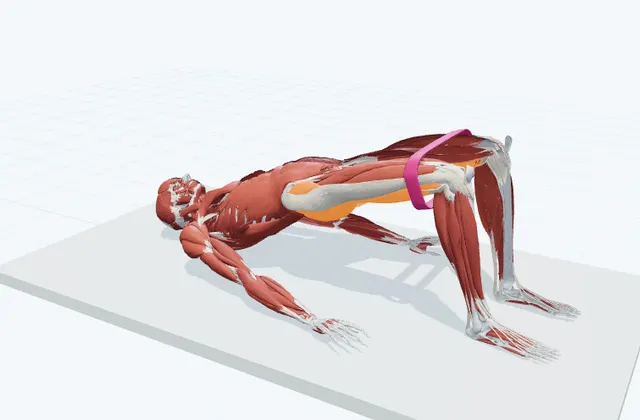
Position and focus
Supine (knees bent) · Lifting the pelvis with the buttocks and the backs of the thighs, keeping the knees out
Starting position
Place the mini loop just above both knees and lie on your back with your knees bent. Put your feet on the floor hip-width apart, with the knees and toes pointing the same way. Rest your arms on the floor beside your body.
Movement phases
1. Set up
Press the knees lightly outwards against the band so it is taut.
2. Lift
Breathing out, press the soles of your feet into the floor and lift the pelvis, buttocks first. Keep pressing the knees outwards.
3. Hold
Hold for 1 to 2 seconds at a height where knees to shoulders are close to a straight line. Do not arch the lower back to lift higher.
4. Lower
Breathing in, lower the spine from the top down, keeping the knees from falling inwards.
What to check yourself
As you lift, are the knees falling inwards? Is the lower back arching? Are the whole soles of the feet pressing the floor?
Coaching points for trainers
If the knees fall inwards, use a lighter band, or start without the band and line the knees up with the toes. If the backs of the thighs cramp, bring the feet a little closer to the buttocks.
Caution
Before use, check the band for nicks, tears or stickiness. Hold or loop it securely on your hands or feet so it cannot slip off, do not pull it towards your face, and do not suddenly let go while it is stretched (it can snap back). Stop if you feel pain, numbness or dizziness. If you are receiving treatment, recovering from surgery or pregnant, check with your healthcare professional. If you are allergic to latex, choose a latex-free band. Keep your shoulders on the floor so no body weight rests on your neck.
These English notes describe a prototype model. The stretch, foam roller and resistance band lessons are being produced under the supervision of CoconeRu. Move, reviewed in stages. They are not medical advice or an individual exercise prescription.
References
Each note describes what the whole source covers.
NHS — Strength exercises ↗
Strength exercises to do at home (sit-to-stand, wall press-ups and others) and the guide of at least two days a week.
Garber CE et al. ACSM Position Stand: Quantity and Quality of Exercise for Developing and Maintaining Cardiorespiratory, Musculoskeletal, and Neuromotor Fitness in Apparently Healthy Adults. Med Sci Sports Exerc. 2011 ↗
Guidance for healthy adults on resistance exercise: how often, how many repetitions and sets, and rest between sessions.
This lesson was put together for this site from the methods for the same area in the sources above. It has not yet been reviewed by an expert.
About this page
It shows a typical way to do the movement. The 3D is a schematic model; it does not decide whether a lesson suits you, prescribe exercise or diagnose anything. Stop if you feel pain or discomfort.
Sources, supervision and revisions