Upper Back Rolling | Foam roller exercise in 3D
Upper Back Rolling: supine, buttocks lifted (roller across the upper back), feeling of tightness in the upper back (around the thoracic spine). Preparation, 4 movement phases, points to check and cautions, with a 3D model you can pause and rotate.
← Back to the foam roller library
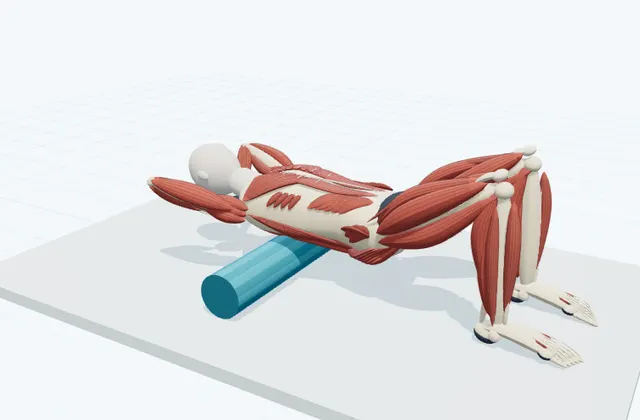
Position and focus
Supine, buttocks lifted (roller across the upper back) · Feeling of tightness in the upper back (around the thoracic spine)
Feeling of tightness in the upper back (around the thoracic spine)
Starting position
Place the roller across your back, just below the shoulder blades, and lie back on it. Bend your knees with your feet on the floor, and support your head with both hands.
Movement phases
1. Set up
Lift your buttocks and rest your upper back on the roller.
2. Roll towards the shoulders
Push through your feet to move your body towards your feet, slowly rolling the roller towards your shoulders.
3. Roll back
At the same speed, come back until the roller is just below the shoulder blades.
4. Lower and rest
Lower your buttocks and rest.
What to check yourself
Is the roller going down onto the lower back? Is the neck tipping back? Are the buttocks lifted so high that the lower back arches?
Coaching points for instructors
Keep the roller between just below the shoulder blades and just short of the shoulders, and cue the client not to let it touch the lower back. Support the head with the hands so the neck does not tense.
Caution
Do not press hard through pain. Stop if you feel sharp pain, numbness or dizziness. If you have osteoporosis, pain under treatment, have had surgery or are pregnant, check with your healthcare professional. Do not roll over the lower back. Stop if you feel sharp pain in your back.
These English notes describe a prototype model. Stretch and foam roller lessons have not yet been reviewed by the supervising instructors. They are not medical advice or an individual exercise prescription.
References and scope
Wiewelhove T et al. A Meta-Analysis of the Effects of Foam Rolling on Performance and Recovery. Front Physiol. 2019 ↗
A meta-analysis of foam rolling before and after exercise. Small improvements in flexibility and sprint performance before exercise and reduced muscle soreness after exercise are reported; the effects are small.
This lesson was put together for this site from the methods for the same area in the sources above. It has not yet been reviewed by an expert.
Related lessons
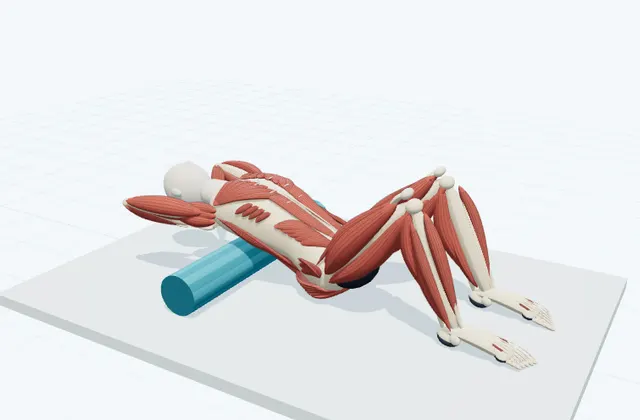
Thoracic Extension over the Roller
Foam roller exercise
Thoracic extension and the front of the chest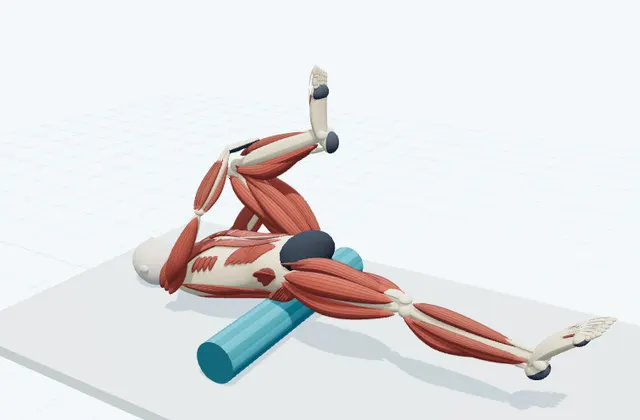
Hip Flexor Stretch with the Pelvis on the Roller
Foam roller exercise
The front of the hip (around the iliopsoas)